
Teleflora Flowers and Plants
fresh flowers hand delivered daily
teleflora
search
Flower Blog
Home > Flower Ideas & Inspirations > Meaning of Flowers

Anniversary Flowers
Astrology Floral Guide
Birth Flowers
Birthday
Flower Color Meaning
Flower Gift Guide
Flower Glossary
Get Well
High-Style Collection
How to Care for Flowers
How to Care for Plants
Licensing Partners
Meaning of Flowers
New Baby
Rose Gift Guide
Sympathy Flowers
Thank You


tulip

THE MEANING & SYMBOLISM OF
TULIP

Originally from Persia and Turkey, tulips were brought to Europe in the 16th century, where they got their common name from the Turkish word for gauze (with which turbans were wrapped) - reflecting the turban-like appearance of a tulip in full bloom.  By the 17th century, the popularity of tulips, particularly in the Netherlands, became so great that the price of a single bulb soared to new heights, causing markets to crash and putting into motion "tulip mania."
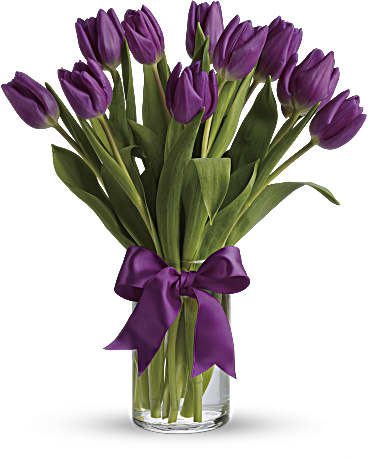
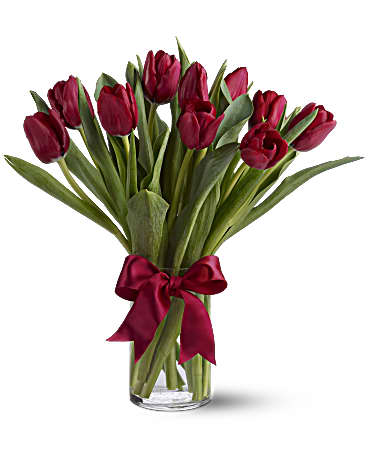
Although different tulip colors carry distinct meanings - yellow tulips symbolizing cheerful thoughts, white conveying forgiveness and purple representing royalty - a Turkish legend may be responsible for the red tulip's symbolism. The story goes that a prince named Farhad was love struck by a maiden named Shirin.  When Farhad learned that Shirin had been killed, he was so overcome with grief that he killed himself - riding his horse over the edge of a cliff.  It's said that a scarlet tulip sprang up from each droplet of his blood, giving the red tulip the meaning "perfect love."
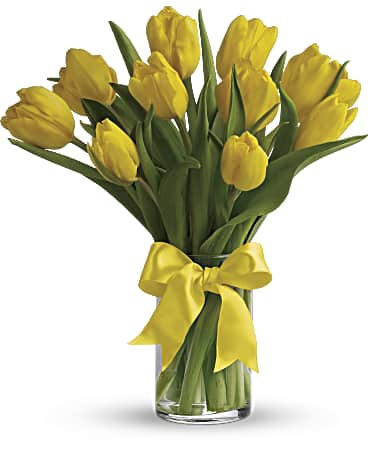
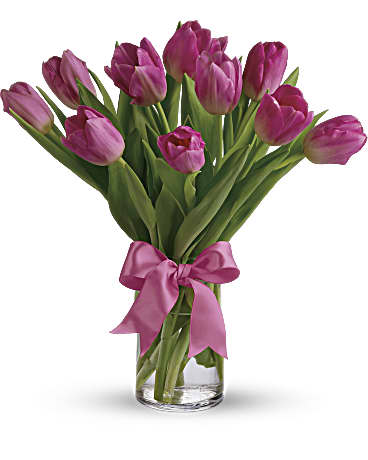
The 11th wedding anniversary flower, it's said that the tulip’s velvety black center represents a lover's heart, darkened by the heat of passion. With the power to rival roses in their red variety and the sweet charm to express simple joy when yellow, it’s no wonder that in addition to all its other symbolism, in the language of flowers, a tulip bouquet represents elegance and grace.

THE BOTANY OF tulips

Tulips make up the genus Tulipa and are among the most popular of all garden flowers. This may be in part because of the wide range of colors available, with the exception of true blue. Almost 4,000 horticultural varieties have been developed.

The name tulip is the Latinized version of the Persian word “dulband” (turban), so called because of the flower’s resemblance to a turban. Turkish men customarily wore tulips tucked in the folds of their turbans. Tulips were introduced to the Western world by a Dutch ambassador to Turkey in the 16th century.

Tulips blossom in early to late spring, depending on the climate in which they are planted. Cut tulips are primarily enjoyed during the same season, although they are now commercially grown to be available as a cut flower all year long.
Tulips continue to bloom annually for a few years but eventually degenerate. It is a common practice to lift the bulb (remove form the soil) after the flowers have dropped and the foliage has yellowed, and store them in a cool dry place until autumn replanting time.

Some tulips varieties have a slight fragrance. Some chefs consider the fresh petals of a tulip edible and use them in salads or on tea sandwiches.
Tulips play an important role in nature. They are a harbinger that spring has sprung and the winter season is almost finished!


Careers   About Us  Affiliate  Find a Florist  Security/Privacy  Delivery Policy   Substitution Policy   Teleflora Guarantee   Site Map 


Copyright Teleflora. All rights reserved.